
Introduction to Crypto Technical Analysis
Cryptocurrency markets move fast. One moment Bitcoin is climbing like it’s chasing the sky, and the next it’s tumbling as if gravity suddenly doubled. If you’ve ever stared at a crypto chart wondering whether to buy, sell, or just close the app and breathe, you’re not alone. That’s where crypto technical analysis steps in.
Technical analysis is the art—and science—of studying price charts to predict future market movements. Instead of digging into a project’s whitepaper or team credentials, technical traders focus purely on price data, volume, and patterns. Why? Because price reflects everything. Every rumor, every news release, every investor emotion—it’s all baked into the chart.
In crypto, technical analysis is especially powerful. Unlike traditional markets that close on weekends or after hours, crypto trades 24/7. That constant movement creates endless patterns, trends, and opportunities. But here’s the catch: without structure, it can feel chaotic.
Think of technical analysis as your market compass. It doesn’t guarantee success, but it helps you navigate volatility with confidence. In this guide, we’ll break down everything—from charts and indicators to patterns and strategies—so you can read the crypto market like a seasoned trader instead of guessing blindly.
Ready to decode the charts? Let’s dive in.
What Is Technical Analysis in Cryptocurrency?

At its core, technical analysis in cryptocurrency is the study of historical price movements to forecast future price behavior. It sounds simple, but the depth behind it is massive.
Technical analysis operates on three key assumptions:
- The market discounts everything.
- Prices move in trends.
- History tends to repeat itself.
Let’s unpack that.
When we say “the market discounts everything,” we mean that all available information—news, social media hype, regulations, fear, greed—is already reflected in the current price. Instead of chasing headlines, technical analysts focus on what the price is actually doing.
Next, prices move in trends. Crypto rarely moves randomly for long. It trends upward, downward, or sideways. Spotting these trends early is where traders make money.
Finally, history repeats itself. Human psychology doesn’t change. Fear and greed drive decisions today just as they did years ago. Because of that, price patterns repeat over time.
Imagine the market as a giant emotional machine. When investors panic, prices drop sharply. When excitement builds, prices surge. Technical analysis helps you recognize these emotional waves before they crash over you.
In crypto specifically, volatility is higher than in stocks or forex. That means technical analysis tools become even more valuable. Indicators like RSI, MACD, and moving averages help filter noise and highlight potential entry and exit points.
If you want structure in a market that often feels wild, technical analysis is your blueprint.
Why Technical Analysis Matters in the Crypto Market
Crypto isn’t just another asset class—it’s a high-speed rollercoaster powered by speculation, innovation, and global participation. Because of this, technical analysis matters more here than almost anywhere else.
First, crypto markets are heavily sentiment-driven. Unlike traditional companies that generate earnings reports, many cryptocurrencies are valued largely based on belief, adoption potential, and hype. That means price swings can be extreme. Technical analysis helps you interpret those swings logically instead of emotionally.
Second, crypto operates 24/7. There’s no closing bell. This nonstop action creates more trading setups but also more traps. Without technical analysis, you’re essentially navigating without a map.
Third, liquidity varies widely between coins. Bitcoin and Ethereum are highly liquid, but smaller altcoins can move drastically on low volume. Technical tools help traders identify whether a move is strong and sustainable—or just temporary noise.
Let’s put it simply. Imagine driving in thick fog. Fundamental analysis might tell you where the road is supposed to go, but technical analysis turns on the headlights so you can see what’s directly ahead.
For day traders, swing traders, and even long-term investors, technical analysis offers:
- Better entry timing
- Smarter exit strategies
- Improved risk management
- Emotional discipline
Without it, trading becomes gambling. With it, trading becomes strategy.
And in a market as volatile as crypto, strategy isn’t optional—it’s survival.
The Foundations of Technical Analysis
Before diving into indicators and patterns, you need a strong foundation. Think of technical analysis like building a house. If the base is weak, everything on top collapses.
The first foundational concept is price action. Price action refers to how price moves over time. It’s raw, unfiltered information. Some traders rely solely on price action without using any indicators. Why? Because indicators are derived from price—they lag behind it.
The second foundation is trend. Markets don’t move in straight lines. They form waves. Recognizing whether the market is trending up, down, or sideways changes everything about your strategy.
The third pillar is volume. Volume shows how much of a cryptocurrency is being traded. A price move without volume is like a car without fuel—it won’t go far.
These foundations work together. For example:
- An uptrend with increasing volume is strong.
- A breakout with low volume is suspicious.
- A downtrend losing volume may signal reversal.
Technical analysis isn’t about predicting the future with certainty. It’s about stacking probabilities in your favor.
Once you master these fundamentals, everything else—indicators, patterns, strategies—becomes easier to understand.
You stop reacting emotionally and start responding strategically.
And that shift? It changes everything.
Price Action and Market Psychology
If you strip away every indicator, every oscillating line, and every colorful overlay from a crypto chart, what’s left? Price. Just raw movement. That’s price action—and it’s the heartbeat of crypto technical analysis.
Price action trading is based on one simple truth: the market is driven by human emotion. Fear, greed, hesitation, excitement—these emotions show up directly on the chart. When buyers overpower sellers, price rises. When sellers dominate, price falls. It’s not complicated. But it is deeply psychological.
Think about a sudden Bitcoin pump. Why does it happen? Maybe there’s positive news. Maybe a big investor made a public endorsement. Or maybe traders simply believe it’s about to rise, so they jump in early. That collective belief becomes self-fulfilling. More buyers push the price higher, attracting even more buyers. It becomes a chain reaction.
The same thing happens in reverse during crashes. Panic spreads faster than logic. Traders sell not because of analysis—but because others are selling. That emotional contagion leaves patterns on the chart.
Price action traders focus on:
- Higher highs and higher lows (bullish structure)
- Lower highs and lower lows (bearish structure)
- Rejection wicks showing strong defense at certain levels
- Consolidation zones before explosive moves
Imagine the chart as a battlefield. Buyers and sellers fight at every level. Long wicks show where one side attempted to push price further—but got rejected. Tight consolidation shows indecision. Strong breakouts show conviction.
Here’s the powerful part: indicators lag, but price action happens in real time. By learning to read the “story” of each candle and structure shift, you begin to anticipate moves instead of reacting to them.
The crypto market amplifies psychology because it’s global and runs nonstop. While one country sleeps, another is trading. That constant emotional flow makes price action especially valuable.
When you understand price action, you’re no longer guessing. You’re reading the emotional language of the market.
Understanding Market Trends

Trends are the backbone of crypto technical analysis. You’ve probably heard the phrase, “The trend is your friend.” It sounds simple, but it’s one of the most powerful principles in trading.
A trend is the general direction in which price is moving over time. In crypto, trends can form on a 5-minute chart or a weekly chart. The timeframe changes—but the concept stays the same.
Markets move in waves. Even in a strong uptrend, price pulls back before continuing higher. These pullbacks are not reversals—they’re pauses. Understanding this difference is crucial.
There are three primary types of trends:
- Uptrend
- Downtrend
- Sideways (range-bound) trend
Identifying the current trend helps you align your strategy. Trading against the trend is like swimming upstream—it’s exhausting and risky. Trading with the trend is like riding a wave—it carries you forward.
Crypto is known for powerful trends. Think about Bitcoin’s historic bull runs. Those who recognized the trend early and stayed patient captured massive gains. Meanwhile, traders who tried to short every small pullback got burned.
Trend analysis also helps with risk management. In an uptrend, you look for buying opportunities. In a downtrend, you consider selling or staying out. In sideways markets, you trade ranges or wait for breakout confirmation.
Let’s break each one down in detail.
Uptrend
An uptrend is defined by higher highs and higher lows. It’s a staircase moving upward. Each peak is higher than the last. Each dip doesn’t fall as low as the previous one.
Visually, it looks like steady upward momentum with temporary pauses.
Why does this structure matter? Because it shows buyers are consistently willing to step in at higher prices. That’s strength.
In crypto, uptrends can be explosive. Retail investors pile in, social media buzz increases, and FOMO (fear of missing out) kicks in. Volume often rises alongside price.
Smart traders don’t chase random green candles. Instead, they:
- Wait for pullbacks to support
- Confirm trend structure remains intact
- Use moving averages for dynamic support
- Set stop-losses below higher lows
The biggest mistake? Thinking every dip means the trend is over. In reality, healthy uptrends need pullbacks. They shake out weak hands before continuing higher.
Patience during an uptrend can be incredibly rewarding.
Downtrend
A downtrend is the opposite: lower highs and lower lows. It’s a staircase moving downward.
Each rally fails to reach the previous high. Sellers dominate. Confidence fades. Fear spreads.
Crypto downtrends can be brutal. Prices don’t gently decline—they cascade. Negative sentiment compounds losses. Traders panic-sell, accelerating the fall.
In a downtrend:
- Resistance levels become stronger
- Bounces are often short-lived
- Volume may spike during sell-offs
- Short positions become favorable for experienced traders
The key lesson? Don’t fight a downtrend blindly. Many beginners keep buying because “it’s cheaper.” But cheap can always get cheaper.
Instead, wait for clear structure shifts before assuming reversal. A downtrend only ends when the pattern of lower highs breaks.
Respect the momentum—even when it hurts.
Sideways Trend
Not every market is trending. Sometimes price moves sideways, bouncing between support and resistance. This is called consolidation or ranging.
In crypto, sideways markets often follow strong trends. It’s the market catching its breath.
During a range:
- Buyers defend support.
- Sellers defend resistance.
- Volume typically declines.
- Breakouts eventually occur.
This phase frustrates trend traders but creates opportunity for range traders. Buying near support and selling near resistance can be effective—if you’re disciplined.
The danger? False breakouts. Crypto is famous for fake moves designed to trap traders before reversing.
Sideways markets test patience. But they also prepare the ground for the next big move.
And when that breakout finally comes? It often comes fast.
Crypto Charts Explained
If technical analysis is the language of the market, then charts are the pages where the story unfolds. Without charts, crypto trading would feel like driving at night without headlights. You might move forward, but you wouldn’t really know where you’re going.
Crypto charts visually represent price movement over time. Every flicker of buying pressure, every surge of panic selling—it’s all plotted there. The beauty of charts is that they transform chaos into structure. Instead of random numbers flashing on an exchange screen, you see patterns, trends, and momentum.
There are three primary chart types every crypto trader should understand:
- Line charts
- Bar charts
- Candlestick charts
Each one presents price data differently. Some are simple and clean. Others provide deeper insight into intraday battles between buyers and sellers.
When you open a trading platform like TradingView or Binance, you’ll usually default to candlestick charts. Why? Because they offer the richest detail. But understanding all chart types gives you flexibility.
Think of charts like camera lenses. A line chart is a wide-angle view—simple and broad. A candlestick chart is a zoom lens—you see every nuance.
The key isn’t memorizing every visual detail. It’s learning to interpret what the chart is telling you. Is momentum building? Are buyers exhausted? Is volatility increasing?
Charts don’t lie. They simply reflect collective human behavior in visual form.
Let’s break them down one by one.
Line Charts
Line charts are the simplest form of crypto price visualization. They connect closing prices over a selected time period with a single continuous line.
That’s it. No wicks. No opening prices. No intraday drama.
At first glance, they might seem too basic. But don’t underestimate them. Line charts are incredibly useful for identifying the broader trend without distraction.
If you zoom out on Bitcoin’s weekly line chart, you can clearly see its long-term growth cycles. The noise disappears. The emotional spikes shrink. What remains is clarity.
Line charts are especially helpful for:
- Long-term investors
- Identifying macro trends
- Spotting major support and resistance zones
- Avoiding overanalysis
The downside? They hide important intraday information. You don’t see volatility inside each period. For day traders, that missing detail matters.
Still, simplicity can be powerful. Sometimes too much information clouds judgment. A line chart forces you to focus on the bigger picture.
It’s like stepping back from a painting. Up close, you see brush strokes. From a distance, you see the masterpiece.
Bar Charts
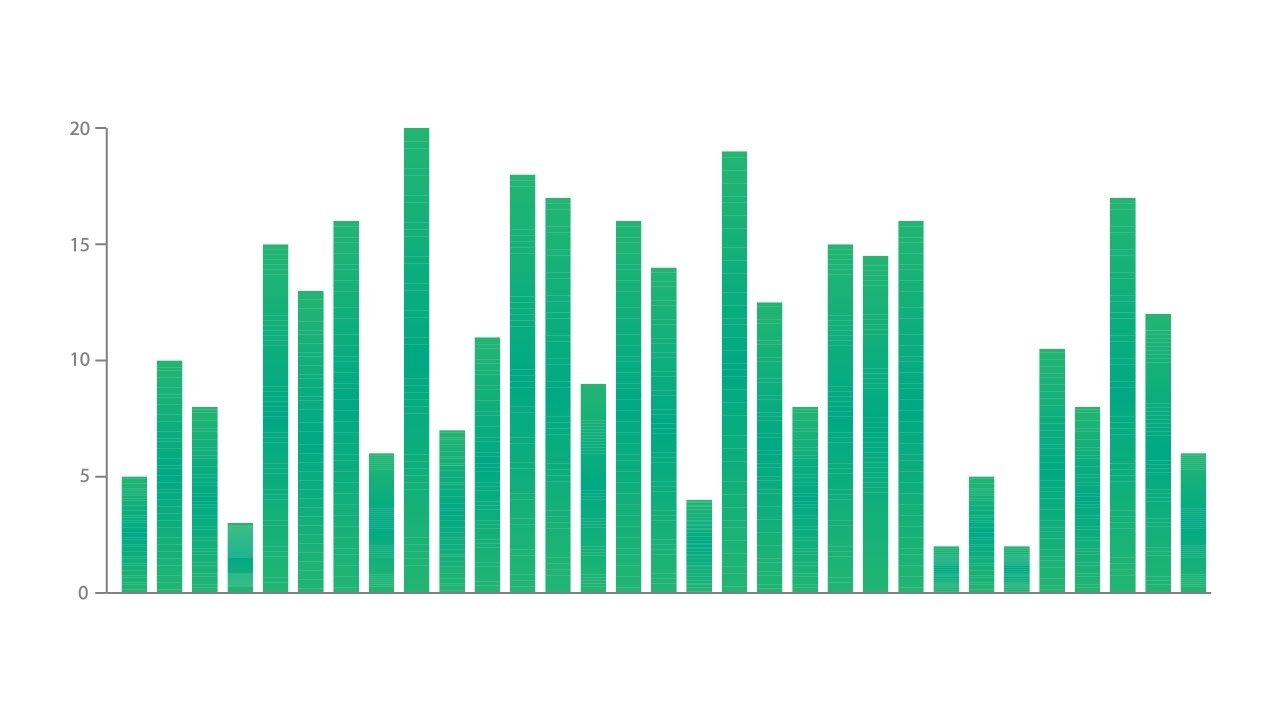
Bar charts add more depth than line charts. Each bar represents four key data points:
- Opening price
- Closing price
- Highest price
- Lowest price
Visually, a vertical line shows the high and low range. Small horizontal ticks indicate the open and close.
Bar charts give traders more information about volatility within a specific timeframe. You can see whether price moved aggressively or stayed contained.
However, bar charts aren’t as visually intuitive as candlestick charts. They require a bit more focus to interpret quickly.
Professional traders sometimes prefer bar charts because they appear cleaner. There’s less color distraction. But for most crypto traders, candlesticks offer better visual storytelling.
Bar charts sit somewhere in the middle—more informative than line charts but less expressive than candles.
Candlestick Charts
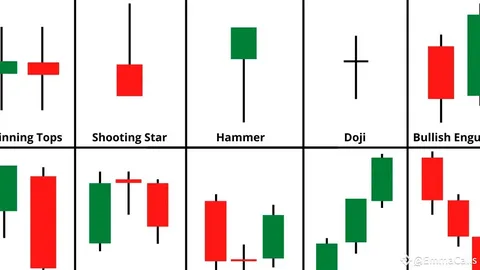
Candlestick charts are the gold standard in crypto technical analysis. If you’ve seen green and red “candles” on a chart, this is what you’re looking at.
Each candlestick represents four data points:
- Open
- Close
- High
- Low
The “body” shows the open-to-close range. The “wick” (or shadow) shows the high and low extremes.
Green (or white) candles indicate price closed higher than it opened. Red (or black) candles show price closed lower.
Why are candlesticks so popular? Because they tell a story instantly. You can see strength, rejection, indecision—all at a glance.
Long green body? Strong buying pressure.
Long upper wick? Sellers pushed price down from highs.
Small body with long wicks? Market indecision.
Candlestick charts make pattern recognition easier. And in crypto—where speed matters—that visual clarity is powerful.
Anatomy of a Candlestick
Understanding the anatomy of a candlestick is like learning the alphabet of technical analysis.
Let’s break it down:
- The body: Represents the difference between open and close.
- The upper wick: Shows the highest price reached.
- The lower wick: Shows the lowest price reached.
If the body is large, it means strong conviction during that period. If the wicks are long, it signals rejection or volatility.
For example:
- A long lower wick often shows buyers stepped in aggressively after a drop.
- A long upper wick may indicate sellers rejected higher prices.
Certain candlestick formations—like doji, hammer, and engulfing patterns—signal potential reversals. These patterns are reflections of psychological shifts in the market.
In crypto, where price can swing dramatically within minutes, candlestick interpretation becomes essential.
Each candle is a snapshot of a battle. And when you line them up side by side, they tell a continuous story of war between bulls and bears.
Support and Resistance Levels
Support and resistance are the backbone of crypto trading strategy. If trends show direction, support and resistance show boundaries.
Support is a price level where buying pressure tends to stop a decline. Resistance is where selling pressure tends to halt an advance.
Think of support as a floor. Resistance is the ceiling.
Why do these levels form? Memory.
Traders remember price levels where significant moves happened before. If Bitcoin bounced strongly from $30,000 in the past, traders expect buyers to defend it again. That expectation becomes reality.
Support and resistance are not exact lines. They’re zones. Price often dips slightly below support or spikes slightly above resistance before reversing.
Key ways to identify them:
- Previous swing highs and lows
- Consolidation zones
- Psychological round numbers (like $50,000)
- Moving averages
In crypto, these levels matter even more because of high retail participation. Emotional reactions often cluster around obvious levels.
When support breaks, it often becomes new resistance. When resistance breaks, it can turn into support. This flip is a powerful confirmation signal.
Mastering support and resistance changes everything. Instead of randomly entering trades, you position yourself near key decision points.
And in trading, location is everything.
How to Identify Support and Resistance
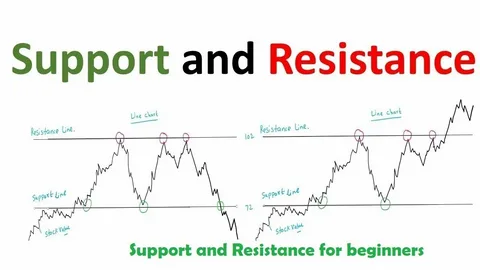
Start by zooming out. Look at higher timeframes first—daily or weekly charts. Major levels become clearer there.
Mark areas where price reversed multiple times. The more touches a level has, the stronger it becomes.
Use horizontal lines—not diagonal ones—for primary levels. Keep it simple.
Ask yourself:
- Where did strong rallies begin?
- Where did major sell-offs start?
- Where did price consolidate before breaking out?
These areas often act as magnets in the future.
Don’t clutter your chart. Too many lines create confusion. Focus on the most obvious levels—the ones everyone else can see. Because if everyone sees them, everyone reacts to them.
Breakouts and Fakeouts
A breakout happens when price moves decisively beyond support or resistance. In crypto, breakouts can trigger explosive moves due to stop-loss liquidations and FOMO entries.
But here’s the twist: not all breakouts are real.
Fakeouts (false breakouts) occur when price briefly moves past a level, traps traders, and then reverses sharply.
How do you filter them?
- Look for strong volume confirmation
- Wait for candle close beyond the level
- Watch for retests of the breakout zone
Patience saves money. Jumping into every breakout blindly is a common mistake.
In crypto, volatility loves to test your discipline. The key is waiting for confirmation instead of chasing excitement.
Because in this market, traps are everywhere.
Moving Averages in Crypto Trading
If support and resistance are the walls of the market, moving averages are the road signs. They smooth out price data and help you see the bigger direction without getting distracted by every little spike or dip.
In crypto technical analysis, moving averages (MAs) are among the most widely used indicators. Why? Because they’re simple, effective, and adaptable to different timeframes. Whether you’re scalping on the 5-minute chart or holding long-term positions on the weekly chart, moving averages provide clarity.
A moving average calculates the average price of a cryptocurrency over a specific number of periods. As new price data comes in, the average updates—“moving” along with price.
Traders use moving averages to:
- Identify trend direction
- Spot dynamic support and resistance
- Generate buy and sell signals
- Confirm breakout strength
Think of a moving average like a river current. If price is consistently above it, the current is flowing upward. If price stays below it, the flow is downward.
In crypto markets—where volatility can blur trend direction—moving averages filter out the noise. Instead of reacting to every red candle in an uptrend, you stay focused on the broader momentum.
There are two main types traders rely on: the Simple Moving Average (SMA) and the Exponential Moving Average (EMA). Both serve similar purposes—but behave slightly differently.
Let’s break them down.
Simple Moving Average (SMA)
The Simple Moving Average is exactly what it sounds like—it calculates the average closing price over a set number of periods.
For example:
- A 50-day SMA averages the last 50 daily closing prices.
- A 200-day SMA averages the last 200 daily closes.
It treats every price equally. Day one has the same weight as yesterday.
The 50 SMA and 200 SMA are especially popular in crypto trading. Why? Because they reflect medium- and long-term trends.
When Bitcoin trades above the 200-day SMA, many investors interpret it as long-term bullish strength. When it drops below, sentiment often shifts bearish.
The SMA works well for identifying broad trends but has one drawback—it reacts slowly. Because it equally weights older prices, it lags behind rapid market changes.
In crypto, where momentum can shift overnight, that lag can be significant.
Still, for swing traders and long-term investors, the SMA provides a stable foundation. It’s like looking at a calm, steady heartbeat instead of every minor fluctuation.
If you want smoother signals and fewer false alarms, the SMA is a reliable tool.
Exponential Moving Average (EMA)
The Exponential Moving Average takes things a step further. Unlike the SMA, the EMA gives more weight to recent price data. That makes it more responsive to current market conditions.
In fast-moving crypto markets, responsiveness matters.
For example:
- A 20 EMA reacts faster than a 50 SMA.
- A 9 EMA is commonly used for short-term momentum tracking.
Because EMAs react quickly, day traders and scalpers prefer them. They help identify short-term trend shifts sooner.
However, faster response also means more sensitivity to noise. In choppy markets, EMAs can generate false signals.
Here’s how traders often use EMAs:
- In uptrends, price frequently pulls back to the EMA and bounces.
- In downtrends, the EMA acts as dynamic resistance.
- EMA crossovers signal potential reversals.
Picture the EMA like a magnet pulling price toward it. During strong trends, price may stretch away—but eventually, it tends to snap back.
In crypto, combining multiple EMAs (such as the 9 and 21 EMA) helps visualize momentum shifts clearly.
The EMA doesn’t predict the future. But it shows where momentum is flowing right now. And in volatile markets, that’s invaluable.
Golden Cross and Death Cross
Two of the most talked-about moving average signals in crypto are the Golden Cross and Death Cross.
A Golden Cross occurs when a short-term moving average (like the 50-day) crosses above a long-term moving average (like the 200-day). This signals potential bullish momentum.
A Death Cross happens when the short-term MA crosses below the long-term MA, signaling possible bearish momentum.
These crossovers often generate headlines in crypto media. When Bitcoin forms a Golden Cross, optimism spreads quickly.
But here’s the reality: crossovers are lagging indicators. By the time they occur, a significant portion of the move may have already happened.
Smart traders don’t rely solely on crossovers. Instead, they use them as confirmation alongside:
- Volume analysis
- Support/resistance breaks
- RSI signals
- Price structure shifts
Think of a Golden Cross as a green traffic light—but you still look both ways before driving through.
Used wisely, moving averages provide clarity and structure in chaotic crypto markets. Used blindly, they can mislead.
The difference? Context.
Popular Technical Indicators for Crypto
Indicators are tools built from mathematical formulas applied to price and volume data. They help traders interpret momentum, strength, and potential reversal points.
In crypto technical analysis, some indicators stand out because they consistently provide useful signals. Among them:
- Relative Strength Index (RSI)
- Moving Average Convergence Divergence (MACD)
- Bollinger Bands
But here’s something important: no indicator works perfectly alone.
Indicators are like spices in cooking. A little enhances flavor. Too much ruins the dish.
Let’s explore the most powerful ones.
Relative Strength Index (RSI)
The RSI is a momentum oscillator that measures the speed and change of price movements. It ranges from 0 to 100.
Typically:
- Above 70 = Overbought
- Below 30 = Oversold
If Bitcoin’s RSI hits 80, it suggests price may be overheated. If it drops below 30, it may be undervalued.
But here’s where beginners get confused: overbought doesn’t mean “sell immediately,” and oversold doesn’t mean “buy instantly.”
In strong uptrends, RSI can stay overbought for extended periods. In strong downtrends, it can remain oversold.
Smart traders look for:
- RSI divergence (price makes new highs but RSI doesn’t)
- RSI bouncing from 40–50 in uptrends
- RSI rejecting 60 in downtrends
Divergence is especially powerful. If price makes a higher high but RSI forms a lower high, it signals weakening momentum.
RSI works best when combined with support/resistance and trend analysis. Alone, it’s helpful. Combined, it’s powerful.
Moving Average Convergence Divergence (MACD)
The MACD measures the relationship between two EMAs. It consists of:
- MACD line
- Signal line
- Histogram
When the MACD line crosses above the signal line, it suggests bullish momentum. When it crosses below, it signals bearish momentum.
The histogram shows the strength of momentum.
Traders watch for:
- Crossovers
- Divergence
- Histogram expansion or contraction
MACD works well in trending markets but can generate false signals in sideways conditions.
Think of MACD as a momentum radar. It doesn’t tell you where price will go—but it shows how strong the current push is.
In crypto, where momentum shifts rapidly, that information is valuable.
Bollinger Bands
Bollinger Bands measure volatility. They consist of:
- A middle SMA line
- An upper band
- A lower band
When volatility increases, the bands widen. When volatility decreases, they contract.
Price touching the upper band suggests strong momentum or overextension. Touching the lower band may signal weakness or potential bounce.
One powerful setup is the “Bollinger Band squeeze.” When bands tighten significantly, it signals low volatility—often followed by explosive movement.
In crypto, squeezes frequently precede major breakouts.
Bollinger Bands don’t predict direction. But they warn you when volatility is about to expand.
And in crypto, volatility equals opportunity.

Markazf.xyz is a dedicated crypto education platform, helping beginners and experienced users understand blockchain, cryptocurrencies, trading, and DeFi. Our goal is to provide clear guides, tutorials, and the latest updates to make crypto learning simple, safe, and effective.